

Friday, June 05, 2026
Thursday, June 04, 2026
What Would Emerge?
In an area that I routinely walk, someone recently cleared a bunch of the heavy foliage that had built up next to the path. Just a few days later there were three or four different kinds of flowers that I had never seen before growing in the cleared area.
Which got me thinking — what kinds of things would emerge in my life, if I were willing to clear out of the way some of the things that have grown up in front of them?

Wednesday, June 03, 2026

Tuesday, June 02, 2026
LT: Ideas From Others
A good leader is curious to hear ideas from others. A bad leader cares more that others hear their ideas.
-- Simon Sinek
Monday, June 01, 2026
As A Society
I'm wondering...about what causes us as a society to fall asleep to what is going on around us (or, for that matter, to wake up).
HISTORY: Four Horsemen of Calumny—Fear, Ignorance, Bigotry, and Smear

The more things change, the more they stay the same.
June 1 is always an important day; per the above, now as much as ever.
An important historical reading...here.
Sunday, May 31, 2026
5 Truths About Sabbath
5 truths about Sabbath:
- Sabbath is not a reward for hard work
- Sabbath is a reminder that our work will remain incomplete
- Sabbath is a day that moves us from production to presence
- Sabbath reminds us that we are not God
- Sabbath points us to the deeper rest we need found in Christ
Saturday, May 30, 2026
3 Observations & A Question
What brings them joy can bring you joy.
You’re either cooperating with a natural order of things or you’re making it harder to do so.
Maybe we’re all on the spectrum…of a spirit of hoarding (or miserliness) on one end and a spirit of generosity on the other.
Imagination often comes from context (we rarely wonder about things we’ve never seen) — wouldn’t that make context pretty important, even if simply from an imagination perspective?
Prior 3 Observations & A Question…

Friday, May 29, 2026
The Other Shoe Doesn't Have to Drop
In case you need this today:
I’ve only been fired once.
Here’s the story. I was sixteen years old and worked about ten to fifteen hours a week at the local Dairy Queen. On most evenings during the closing shift, I was left running between the drive-through and the kitchen to cover the needs before closing down for the night. Which was when it happened. This was the point in the day when my friends from school would come through the drive-through to sneak in a hello or just make fun of me for working at Dairy Queen (I had great friends!). One Friday night, however, as my friends drove through, I made the ill-fated decision that would change my life forever. Continue...here.
-- A.J. Swoboda
Thursday, May 28, 2026

Wednesday, May 27, 2026
Take The Space
One way to respect yourself is to take the space that you need — to make space. To be in silence long enough to hear what is really going on...in and around you. 
Ivins, Utah
…from a recent space-taking time for me that was the genesis of this thought.
After all, it isn’t as much about how much you can take in as it is about the other space you have to create to do something with it.
But, you may have to choose it, intentionally.
Leave your phone some place, rather than take it with you.
Plan and go for a hike.
Stop being productive for a minute or a couple of hours (...a couple of days would be even better for you).
Find a way to experience some silence. Unending noise (especially the thinking kind) is not good for you. But, you will have to choose a way to get away from it, otherwise it will just keep you surrounded by it. You may actually have to relearn how to listen to yourself again, to get past the usual tape running in your head.
Taking the space you need is a matter of self-respect, as all care is.
And, yes, you do need it.

Ivins, Utah
Tuesday, May 26, 2026
Monday, May 25, 2026
Memorial Day
Memorial Day this year provokes so much we almost feel soul-numb to its import, at least on the political side of things.
Sometimes we just need someone else to verbalize for us what we're feeling...like this reflection on gardening and democracy from Diana Butler Bass:
A Victory Garden for DemocracyShe reminded me why I plant flowers about this time every year...the joy of it comes from a kind of hope it represents.

HISTORY: Memorial Day
Memorial Day — a history...here:

If we can’t be honest about the past, how can we build a truly better future?
Sunday, May 24, 2026
No Person Can Separate Themselves
The love of God creates in us such a oneing that when it is truly seen, no person can separate themselves from another person.
-- St. Julian of Norwich
Saturday, May 23, 2026
3 Observations & A Question
It’s the habits you form while you’re waiting that become critical.
You can’t subcontract your own thinking…or shouldn’t.
People will believe almost anything — that's part of the problem because it is very hard to unbelieve something.
So, what have you discovered that gives your life meaning?
Prior 3 Observations & A Question…

Friday, May 22, 2026
INSPIRATION
'Poem for the week' -- "INSPIRATION":
This planet will not
be healed
by powerful politicians
in big cities
who spend trillions
on a global strategy
that never quite begins.
They also burn
much fuel.
Earth will be healed
by villagers
who sing,
by backyard gardeners
like you,
who walk more slowly
right here,
who feel the green
through bare soles,
speaking fewer words,
cradling
each others anger
like mothers,
awakening
the heirloom seeds
of the heart.
Thursday, May 21, 2026

Wednesday, May 20, 2026
To Be Human Is To Be Vulnerable
Truth be told, even more than success, control or the effective management of ones life, what we really want from other people is their humanity.
And, by humanity, we mean vulnerability. In fact (if we were really honest), we privately despise the UNvulnerable person, don't we? We want to be like them...AND we don't.
Let's break this down a bit.
In our perhaps less thoughtful moments, we love successful people or, at least, we think we do. But, why then do we also almost fetishize their downfalls (loving that almost more)?
Perhaps this is because we like to think of the possibility of success in our own lives and often live that vicariously through the success of others. We could be successful, too, IF we really wanted to.... We also know, however, that we are often not what we like to think we are (or even could be). More often, the best we do is have moments of flashing success. But, we never sustain it, especially perfectly. In fact, we have a love-hate relationship with ourselves about that reality — loving the notion of what we could be (and sometimes are) and hating ourselves when we are not that.
This is both an unfortunate and vicious construct. The only relief we get from the resulting trauma it often creates is when we acknowledge the both-and nature of it. And, this happens more often than not when we see vulnerability in someone else first and when that allows us to forgive ourselves for our imperfections.
Even that is a rather silly way of framing it. But, we still relentlessly drift towards it, don't we? It must, somehow, be useful to us. I suspect it's utility is primarily based in its distraction, when it really could much more be the means of being liberated from the tyranny of it.
No one is perfect or successful all the time. We wouldn't ever publicly admit to wanting to be. Yet, we do.
The emotion we often feel when we experience genuine vulnerability is the salve for the wounds we create for ourselves from it. We see it in ourselves, but are afraid to admit it (out loud). But, when someone else does, we breathe a sigh of relief as much for our own sakes as anything else. They are like me. I am like them. We are alike, in our vulnerability as human-beings — we call this collective experience our humanity. Vulnerability reinstates the permission we need to give ourselves to be more fully what we really are...human. Not things like successful. Human. Together.
It is that last notion that really captures the concept here. Our greatest vulnerabilities are really with each other — our greatest successes and deepest failures...combined. In spite of some of those who have tried not to be, we by and large are social creatures (what isn't, in fact?). The isolation we impose on ourselves through arbitrary constructs, like success, is really quite...unnatural.
Vulnerability is like a connector...it connects you to the rest of the world.
-- Phil Stutz
Some of how we can learn to get better at this kind of thing is to develop a better relationship with the false binaries of our discomfort with our knowing and our not knowing — with things like our fears and pain. In the end, we have to hold ambiguity, inter-dependence, and the unknown in much more healthy ways. This read about collapse and catastrophe is a helpful consideration.
Tuesday, May 19, 2026
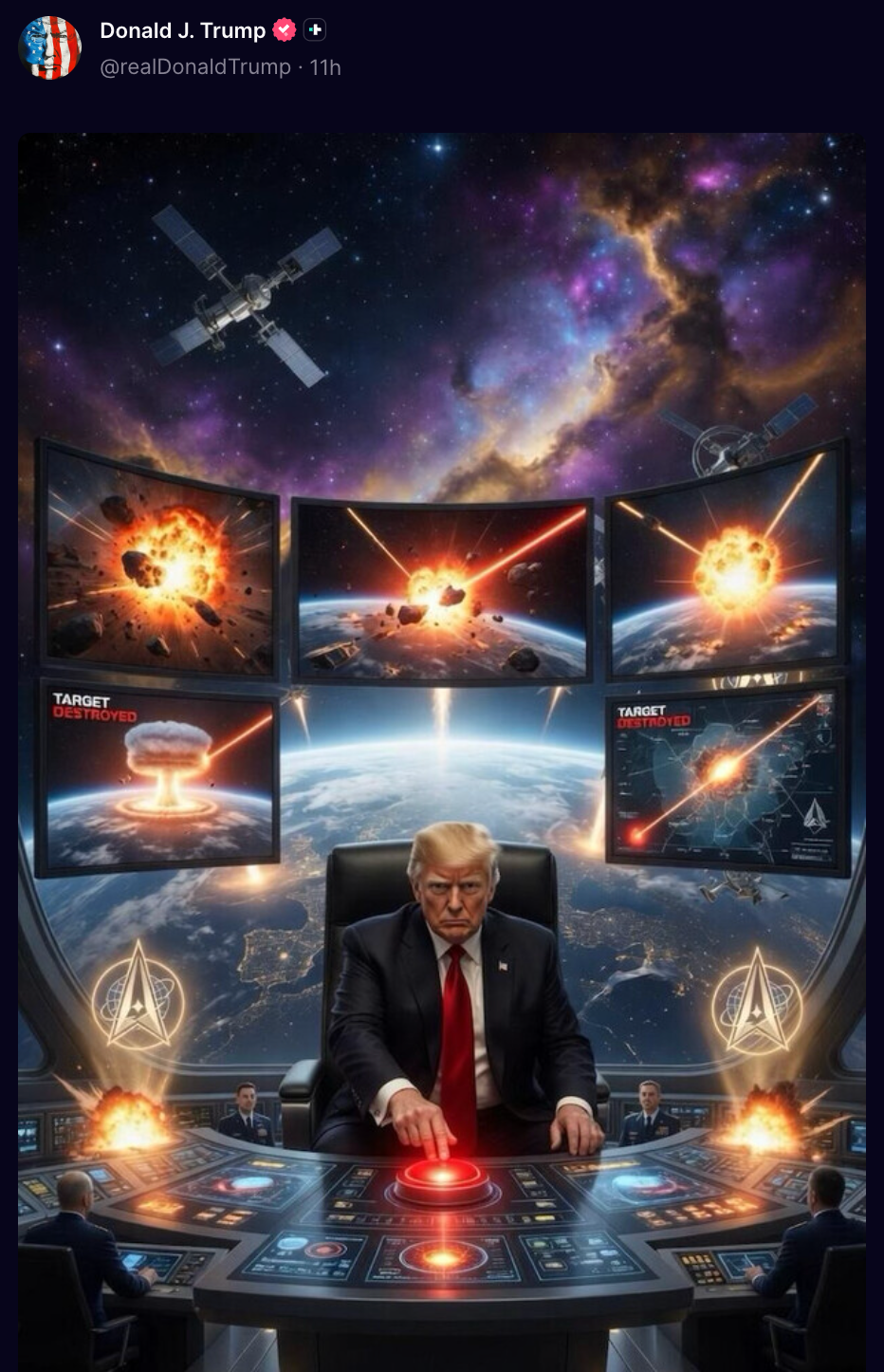
Another, Seriously — This Is Our President?
Another, Seriously — This is our President?:
Trump’s Derangement on Full Display in Most Unhinged Social Media Night Yet:
Oh, and believe it or not:
A document—this time signed by Blanche himself—amended the previous agreement to add: “The United States RELEASES, WAIVES, ACQUITS, and FOREVER DISCHARGES” Trump, his sons, and the Trump Organization, “and is hereby FOREVER BARRED and PRECLUDED from prosecuting or pursuing, any and all claims” that, as of yesterday, “have been or could have been asserted” by the IRS against them or “related or affiliated individuals” or companies. In other words, Blanche is asserting a blanket promise to stop all IRS audits of Trump’s taxes and not to prosecute any crimes Trump, his family, his businesses, or his associates might have committed that crossed the IRS.
-- Heather Cox Richardson, Letters from an American
Speaking of corruption (I mean, money):
Behind the Curtain: Trump's unprecedented profit and protection
It's pretty clear, most MAGA people have no real idea what Trump has always meant by 'great' in his slogan (he doesn't have them in mind at all...other than how he can use them for his own personal gain).
Monday, May 18, 2026
My Discipline
I’ve noticed…that my discipline is increasingly becoming focused on what I need to pay attention to, in any given moment.
In other words, what needs my attention now? Can I pay attention to that later?

Sunday, May 17, 2026
Political Changes
We must not imagine that political changes of themselves will ever bring about the goodness, charity, or transformation that the gospel offers the world.
-- Richard Rohr
A more helpful (and healthy) orientation to change can come from an often uncommon understanding of what is commonly known as the Beatitudes. 'Blessed are the...' meaning not nearly as much a reward as a description of what pathway to flourishing and a genuine state of aliveness really is.
For example, regarding:
"Blessed are the poor in spirit, for theirs is the kingdom of heaven."
A better understanding would be:
"Flourishing and fully alive are those who have created genuine inner space — who have released the accumulated constructions of the conditioned self and made room for something else to enter."
If you're curious and open, continue...here.
...quite a contrast to much of what currently seems to motivate political change.
Saturday, May 16, 2026
3 Observations & A Question
Too often we don’t even know how our fears are operating within us.
Few things have happened in my life that have not ended up being repurposed.
You should say no to at least one thing fairly routinely — if nothing else, to remind you that you can.
At some point, don't you really have to ask yourself why you trust what you trust?
Prior 3 Observations & A Question…
Friday, May 15, 2026
Commencement Address - Arizona State University, Harrison Ford
It's 'commencement' time again:
Passion brings you joy. Purpose brings you meaning.
-- Harrison Ford, commencement address at Arizona State University
Thursday, May 14, 2026
Another, Seriously — This Is Our President?
Another, Seriously — This is our President?:

This one seems more true than even he knows:
I don't think about Americans' financial situation.
-- Donald Trump
But, he says all kinds of things that aren't true...so many, in fact, it's hard to know if anything he says is. More examples:
U.S. Intelligence Shows Iran Retains Substantial Missile Capabilities
Trump is about to pull off the biggest con in American history
DOJ Drops Charges Against 100+ January 6 Defendants...you just can't unsee this stuff. But, we can't keep up with all of it either and Trump knows that (which is why his quip above seems more and more true by the minute).
Don't know how directly related this is (but, I'm guessing it might be...):

Tuesday, May 12, 2026
Great Companies
Great companies don't hire skilled people and motivate them. Great companies hire motivated people and inspire them.
-- Simon Sinek
Monday, May 11, 2026
The More You Have
Ever noticed...the more you have, the greater the tendency to think about what you have to lose?
Image what this looks like on scale (well, I guess you don't have to imagine it; you can just watch it happening right now)....

Sunday, May 10, 2026
Motherhood of God
“This beautiful word ‘mother’ is so sweet and kind in itself that it cannot be attributed to anyone but God.” With these words, Julian offers us an amazing and foundational statement. She is not saying that the most beloved attributes of motherhood can analogously be applied to God, although I am sure she would agree they could. She is saying much more—that the very word mother is so definitive and beautiful in most people’s experience (not everybody’s, I must add) that it evokes, at its best, what we mean by God. This perspective is not what most of the world’s religions have taught or believed up to now—except for the mystics. Among these, Julian of Norwich stands as pivotal. Continue...here.
-- Mirabai Starr, on the medieval mystic Julian of Norwich
I am so grateful today to be able to honor the amazing mothers in my life — my own mother, the mother of our wonderful children, and the mothers they now are or that they’ve married. Like an ever-deepening well, all of you continue to so beautifully give of yourselves to each of your children. Seeing your collective and unique care is both a wonder and profound joy.
Saturday, May 09, 2026
3 Observations & A Question
Live like you actually believe it (vs the alternative).
Make you sure you notice when you don't think you can afford to give.
We are not designed to know everything; that is, we are not constitutionally able to hold knowing all things.
Just because you don't know what will happen, doesn't mean it will likely be bad, right?
Prior 3 Observations & A Question…
Friday, May 08, 2026
Count Your Blessings, but Count Carefully

I’m obsessed with the idea that a guy who wears jeans and drives a Jeep today is basically the same creature that wore animal skins and lived on hand-caught river fish 20,000 years ago. Those beings had the same basic physical and emotional needs, but had to meet them with very few tools and amenities.
I’ve previously described my favorite illustration of this point: imagine a group of prehistoric hunter-gathers, who didn’t even have textiles yet, discovering a modern landfill. It would be an unimaginable sea of blessings: tools, materials, clothing, food, and ideas galore. The hundreds of circling seagulls alone would be a such a blessing they’d tell the story for generations. They’d build the first city there and write the great blessing-pile into their scriptures.
Modern people are accustomed to such an abundance of even better blessings that the hunter-gatherer’s great blessing-pile is actually our refuse — an embarrassing heap of dirty, relatively hard-to-use stuff that we bury in the ground.
We have the same vulnerabilities as our premodern ancestors: disease, loneliness, fear, shame, and death. But we have so many unearned blessings for contending with those problems that...continue here.
-- David Cain
Thursday, May 07, 2026
Conscience
Do we still have a conscience? Can conscience become corrupted?
Our sense of conscience is so baked in that we all tend to think we know exactly what it is. But, do we?
I guess first of all, we have start with some working definitions:

Among other things, one could probably assert that conscience is a sense of what is right and wrong. When the application of it gets specific and is tested, we revert to a sense of what it must be. In many ways, it is a strange brew (somewhat inconsistent view) of what we think or feel personally and how we corroborate that with what we think or feel collectively.
In other words, we seem to have some awareness that, besides the content itself, there are at least two influences in what we think or feel is right or wrong. One is what we think (ostensibly) by ourself and, two, how that jives with what others think. We are often balancing where either one is, by itself, not right in order to come up with a working understanding that is worthy of reinforcement.
Drivers involved in the very founding of our country (some of which are captured in our Constitution), views on abuses in things like slavery, law enforcement, war, religion, the environment, and personal relationships are all examples of where a sense of conscience is involved. We might say about something in any one of these contexts that something just isn't...right. Something isn't good. And, that we need to DO something about it.
Fast-track this then into our current cultural context. It can feel like, especially in the public arena, we have lost something — something involving our conscience. Something isn't right. And, if that is true collectively, then that might implicate each of us personally. Because this is where some of our conscience comes from.
In fact, even as our sense of what is right and wrong is awash in all kinds of sources of information to evaluate it, we can see a persistent stance re-emerging about what all of this is adding up to, including whether or not it is good for us (personally and collectively).
All of this drops us off a bit at the door of the second question we started with. How malleable is our conscience? In other words, is it a fixed thing or can it be significantly influenced, even corrupted?
If you benefit from your sense of right and wrong or good and bad, does that reinforce what we refer to as conscience? What if you don't benefit? What if you are harmed by it? How does your sense of "that's just not right" manifest then? And, what factors play into this more than others?
You probably know that the cost of things, even basic things like your utility bills, are being significantly impacted right now by the data centers that are driving AI. Is that OK? Well, if you can afford it, maybe 'I guess so' still works. Whenever you want it, you get the benefit of being able to look up nearly anything you want online and getting an amazing array of results that can often be useful to you. But, what about the depletion of our water supply to support it? When would that be a real problem? How much harm would it take?
What about ICE? Is what ICE is doing OK? Well, you may not mind the principle, but what about how they are doing it — what about the abuses?
How about government use of your personal data? Well, they know anyway right? What about when they arrest you because of something you said about the government? What if they create lies to manipulate how you vote? That's OK, if it's about the Democrats? What about if its about a fellow Republican?
What if it’s about how your tax dollars are used, including creating war?
The point is, there is a line somewhere. Even if it's different for different folks, because of how they are benefited or harmed, there is still a line.
It's our conscience that helps us with where it is.
Wednesday, May 06, 2026
Things That Matter Most

In the end these things matter most: How well did you love? How fully did you live? How deeply did you learn to let go?
-- Jack Kornfield
Tuesday, May 05, 2026
Whatever Is In Hand
Don't be nervous. Work calmly, joyously, recklessly on whatever is in hand.
-- Henry Miller
Monday, May 04, 2026
Another, Seriously — This Is Our President?
Another, Seriously — This is our President?:
Late on Friday night, President Donald J. Trump took to social media. At 11:03 he posted an AI-generated image of himself, alongside Vice President J.D. Vance, Secretary of State Marco Rubio, and Secretary of the Interior Doug Burgum, all shirtless, along with an unidentifiable woman in a bikini, appearing to be relaxing in a swimming pool. But the “swimming pool” was the reflecting pool in front of the Lincoln Memorial in Washington, D.C.
Then, at 11:04, Trump posted an image of First Lady Melania Trump grinning at the press conference Trump held after the incident at the White House Correspondents’ Dinner, when he said that incident proved he needed his proposed ballroom for his security.
Then, at 11:13, Trump posted an image of....
...
On Wednesday, Trump talked to Russia’s president Vladimir Putin for an hour and a half—the twelfth phone call between the two leaders since Trump took office a second time—and just hours later posted about removing U.S. troops from Germany. Continue here.
-- Heather Cox Richardson, Letters from an American

Sunday, May 03, 2026
Bad Theology

Saturday, May 02, 2026
4 Observations (from Others)
Wealth isn't a distinction. If I have no other achievement to my credit than the accumulation of wealth, then I have made a poor success of my life.
-- John D. Rockefeller
We are not given a short life but we make it short; we are not ill-supplied with time but wasteful of it.
-- Seneca
What we find in life is based on where we put our attention. When we focus on the small worlds our thoughts create, we miss out on the beauty and possibilities we are meant to enjoy.
-- Guy Finley
The moral quest has never kept us moral; it’s just kept us from each other. So maybe we should abandon the moral quest … and embrace instead the journey to wholeness, flourishing love, and defiant joy.”
-- Father Gregory Boyle
Prior 4 Observations (from Others).
Friday, May 01, 2026
Thursday, April 30, 2026
Should Scare The Hell Out of Pentagon Planners & Other Things To Be Worried About

I’d like to hear the truth. That would be pretty remarkable from this Secretary of Defense.
-- Rep. Seth Moulton (D-MA), a military veteran told me about his expectations for Hegseth’s testimony

How the government is ramping up mass surveillance with AI-driven tech
Entire NSF science advisory board fired by Trump administration

...from the official social media account of the White House no less.
Wednesday, April 29, 2026

Tuesday, April 28, 2026
LT: Why Kindness is the Ultimate Command of Modern Leadership
In our pursuit of professional excellence, we frequently overlook the most fundamental element of any organization, a hidden dimension to leadership that doesn’t appear on a balance sheet, yet dictates the success of every organization on earth: the human heart.
Even in the age of AI, the soul of a world-class organization remains human. The most profound strategy a leader can adopt is simple: Be kind because everyone you lead is fighting a battle you know nothing about. In a world that often feels increasingly cold and transactional, this isn't just a sentimental quote to hang on an office wall. It is a strategic imperative. When we trade 'command and control' for 'care and connect', we stop seeing employees as resources and start seeing them as the heartbeat of our success. Kindness is the bridge to a new era of leadership. Continue...here.
-- Gifford Thomas

Monday, April 27, 2026
Notice Things
I’ve noticed…that I notice things.
Everybody does, at least to some extent.
An interesting question though might be, why?
Why do you I notice what I notice (and what I don't notice...and, why?)?
Sunday, April 26, 2026
The Conversation Between
The conversation between your life and God is always happening — the question is whether you hear it.
-- Scott Erickson
Saturday, April 25, 2026
3 Observations & A Question
We control so little beyond our effort.
Doing is often as instructive as thinking about doing.
Just because you’re used to the cost, doesn’t mean that it still doesn’t cost you.
Letting go can often be difficult — have you noticed when that is more often the case?
Prior 3 Observations & A Question…
Friday, April 24, 2026

Thursday, April 23, 2026
Lose Sight

-- William Faulkner
Wednesday, April 22, 2026
Earth Day 2026
We have forgotten how to be good guests, how to walk lightly on the earth as its other creatures do.
-- Barbara Ward, economist, writer, and founder of the International Institute for Environment and Development
For Earth Day, from earthday.org:
Progress does not happen in silence.

It happens when people show up.
Environmental progress is built through everyday action—from communities protecting ecosystems to innovators advancing solutions. Clean air, safe water, and climate resilience aren’t optional—they’re essential.
For Earth Day 2026, we’re mobilizing at scale. Every action counts. Every voice matters.

All flourishing is mutual.
-- Robin Wall Kimmerer, Braiding Sweetgrass
Tuesday, April 21, 2026
Self-Sabotage
Most people self-sabotage with self-defeating attitudes and behaviors long before anyone stops them.
-- Shane Parrish
Monday, April 20, 2026
Small and Insular
Ever noticed...that many people are just trying to get something they want (usually, for the perceived benefits that would come with it) and that, then, they spend the rest of their time trying not to lose it.
...what a small and insular way to live.
Sunday, April 19, 2026
Way of Faith
The way of faith is not a way of certitude.
Certitude is a way of knowledge.
We are all called to a way of faith. At each step God asks us to trust, to say yes, to put our lives in God’s hands.
-- Richard Rohr

Saturday, April 18, 2026
3 Observations & A Question
It seems like pain is required to keep our attention.
Coerced behavior is almost always short-lived — you may get the behavior, but not the heart behind it.
Put yourself in the best position you can — and recognize that you don't hold all the cards (or, even many of them).
Is there anything more significant than a present and patient father?
Prior 3 Observations & A Question…
"Hate To Be Controversial"

Yeah right…isn't controversy his whole gig?
This kind of white-washing and lying has to stop here, too:
What has been happening here since 2010 is something that Goebbels or the North Korean leadership would admire. Not a single true word being spoken. This cannot continue.
-- Péter Magyar, newly elected Prime Minister of Hungary
Friday, April 17, 2026

Thursday, April 16, 2026
Face the Future, Con't
Another lingering reflection, on a recent I'm Wondering...:
I'm wondering...about how we orient ourselves to face the future.
For one thing, how am I thinking about the future relative to how I thought about it in my 20s seems quite different. Obviously, the time-table has changed and that seems to affect things. When I was younger, my sense of 'my whole life in front of me' would often take the pressure off something. As I age, I would describe that pressure as shifting. I'm increasingly focused on a shorter term (like a window is closing — which relieves things in some ways, but adds things in other ways).
Another feature of how we orient to the future seems to be related to fear. I've noticed that fear in older people seems to increasingly dominate their perspective about the future. I've said I won't let that happen to me. But, I suspect I am a bit naive (if not arrogant) about that assertion (even if I don't watch FOX News).
And, then, there's the nexus of my own personal, little world and that of the larger collective that continues to evolve over time. How does what my grandparents remember about 'when they grew up' assimilate with what we're experiencing now in terms of things like social and environmental issues, politics, technology, and our sense of meaning in life? How does what my grandparents faced as children and what my grandchildren will face affect how I view things today?
Like it or not, a lot of the time, how I view things today is psychologically impacted by my sense of the future. Are we progressing or are we retreating? Gaining ground or losing it? Is the future bright with possibility and betterment or beset by the inevitability of dystopia?
So, in all of this, what do I turn to for a sense of my bearings? What gives me healthy perspective about the future? How does my perspective of the future inform what I focus on today (or, is it the other way around)?
Is the future just an abyss waiting for all of us to just fall into? Or, does it largely resemble the present evolution of the past (even as it is changing)? Is what I am really grasping at whether or not anything (or anyone) has control of the future…of where things are headed?
As much as things change, they also stay (largely) the same. Or, at least, the basics do. The sun rises every day. Gravity is always there. Air to breath is a given. Most days, we get up and do our thing — eat (by the way, a helpful way to do that...here), work, clean, etc. Sure we have nicer clothes, indoor plumbing and climate controlled temperature, the ability to communicate and entertain ourselves at unprecedented levels, to fly nearly anywhere in the world now (whereas before, many people never traveled out of their own community), not to mention outer-space. But how much has that capability altered the essential nature of my existence — of what matters most in any given moment?
In other words, what will be is more like what it has always been. If that is true, then most of my future is related to today — to what I do today. If nothing else, the past demonstrates that. And, that is a significant part of how I can face the future...today.
...not to mention the wisdom and faith I benefit from every day from those who have gone before me (both recently and long ago).
Wednesday, April 15, 2026

Subscribe to:
Posts (Atom)