Only a true natural servant automatically responds to any problem by listening first.
-- Robert Greenleaf, The Servant as Leader
Listening enables servant-hood like servant-hood enables leadership.

Tuesday, July 31, 2018
Monday, July 30, 2018
What If: Actually You
What If...because something was so big:
you thought something else that moved each day, was actually you.
you thought something else that moved each day, was actually you.

Sunday, July 29, 2018
It's Theatre

Instagram: bobgoff
When It matters more what our faith looks like than what it is, it isn't faith anymore, it's theatre.
-- Bob Goff
Saturday, July 28, 2018
Wholehearted & Half-Assed

If I could write a book right now, I would consider titling it ‘Wholehearted & Half-Assed’. So, you ask, what would the sub-title be?
When I sit on this bench for a while and notice what is in front of me — what is moving, what isn’t moving — I find myself noticing how different the economy here is than the one I so often swim in. Among other things, this one seems to have no regard for selling and buying; and, it appears to be doing just fine with that. What is this one revealing?
Tami just finished, and I am now reading, Brené Brown’s book, Daring Greatly. Brown offers something surprising. For example, if I were to ask this question, “What is the reward of vulnerability?”, how would you answer? “Wait, what?”, you say? Again, what is the real reward of vulnerability?
Brown’s answer is: greater courage.
So, when I see something that looks like something that is truly real — that isn’t swimming in a false economy — what does it seem to call to in me?
I think it is something more wholehearted and something that is less concerned about how well I do it. Do it. Do it, even if it isn’t great, finished, completely thought through, perfect or final. Do it. Learn from the mistakes. Make it better. Grow from it. But, go for it. Be wholehearted and don’t let the possible assessment from someone else that it looks half-assed keep me from doing it.
Because risking vulnerability actually creates more courage.
Friday, July 27, 2018
Credo
Poem for the week -- "Credo":
I sing the will to love:
the will that carves the will to live,
the will that saps the will to hurt,
the will that kills the will to die;
the will that made and keeps you warm,
the will that points your eyes ahead,
the will that makes you give, not get,
a give and get that tell us what you are:
how much a god, how much a human.
I call on you to live the will to love.
-- Alfred Kreymborg
I sing the will to love:
the will that carves the will to live,
the will that saps the will to hurt,
the will that kills the will to die;
the will that made and keeps you warm,
the will that points your eyes ahead,
the will that makes you give, not get,
a give and get that tell us what you are:
how much a god, how much a human.
I call on you to live the will to love.
-- Alfred Kreymborg
Thursday, July 26, 2018
Wednesday, July 25, 2018
Group Value
Are we primarily valued in a relationship or by a group because of what we contribute to it? Of course, this is not rocket-science folks, right?
But, there are times when it feels like we are not valued, IF we don't contribute.
There is merit to the idea of everyone doing their part to help in a relationship, a group, a team, etc. Certainly; where would we be without such things as mutuality?
On the other hand, at times, it also seems easy to see that if you don't keep up your 'contribution', your value (to whatever the entity is) seems to go down. And, from that angle, sometimes it is clear that this is a rather awful basis for things to run on because it inadvertently (perhaps?) leads to unstated things like: "we don't really like you for who you are, we just like you for what you do for us (our group)"...or, more personally, "I don't like you so much, but I do appreciate what you do for me".
An unfortunate irony is that, as long as you keep contributing, true value can go on unacknowledged for some time in a group.
But, there are times when it feels like we are not valued, IF we don't contribute.
There is merit to the idea of everyone doing their part to help in a relationship, a group, a team, etc. Certainly; where would we be without such things as mutuality?
On the other hand, at times, it also seems easy to see that if you don't keep up your 'contribution', your value (to whatever the entity is) seems to go down. And, from that angle, sometimes it is clear that this is a rather awful basis for things to run on because it inadvertently (perhaps?) leads to unstated things like: "we don't really like you for who you are, we just like you for what you do for us (our group)"...or, more personally, "I don't like you so much, but I do appreciate what you do for me".
An unfortunate irony is that, as long as you keep contributing, true value can go on unacknowledged for some time in a group.
Tuesday, July 24, 2018
LT: The extreme leadership that got the Thai soccer boys out of the cave alive
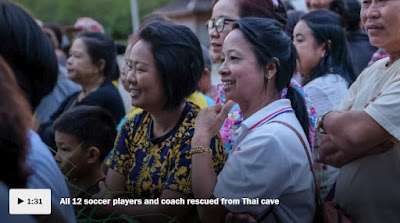
Five themes emerged. The first is something called “inherent motivation.” Leaders who do well in crisis tend to be low motivators. They do not fire people up, they tend to calm people down. Dangerous places are inherently motivating — people are already spun up, so if you go in there and act like a cheerleader, they think you’re a fool.
The second was what we call an “outward orientation” or “learning orientation.” People used to being in dangerous places learn to focus on the environment — they’re not thinking about themselves. They're not focused on their own emotions. When you are task-focused, you’re activating a different part of your brain than the part where you experience fear and anger.
The number one variable — far and away — was competence. They want to know: Is that leader good enough to get us out of this fix? And the second thing they want to know is will that leader be loyal enough to take our concerns and considerations into account when he or she makes decisions? If those two things are established — competence and loyalty — they’ll trust that leader. Continue here....
-- Jena McGregor
Monday, July 23, 2018
Open To Criticism
I've noticed...that when I am less open to criticism, it is often related to a belief I am holding on to.
The belief I recognize the most is that I have not been heard (and, that I really need to be heard). This tends to block me from receiving criticism from others.
The belief I recognize the most is that I have not been heard (and, that I really need to be heard). This tends to block me from receiving criticism from others.
Sunday, July 22, 2018
Why Jordon Peterson Still Believes In God
"Scientific truth explains what things are. Religious truths explains how you should act."
Saturday, July 21, 2018
7 Skills That Are Hard To Learn But Pay Off Forever
7 Skills That Are Hard To Learn But Pay Off Forever:
More here....
-- Travis Bradberry
- Knowing when to shut up
- Emotional intelligence (EQ)
- Time management
- Listening
- Saying "no"
- Getting high-quality sleep*
- Staying positive
More here....
-- Travis Bradberry
Friday, July 20, 2018
Visual: Opening Beliefs
Visual - "Opening"


St. George, Utah
A visual representation of the process of 'Loosen Your Beliefs'? ...long, slow, over time — that opens things up, even in rock-hard environments.
Thursday, July 19, 2018
Loosen Your Beliefs
In order to live your soul into the world, you must continuously loosen your beliefs about who you are.
-- David Whyte
-- David Whyte
Wednesday, July 18, 2018

Tuesday, July 17, 2018
Monday, July 16, 2018
What If: At The Edge
What If...because something was so big:
you thought something in the center, was actually at the edge.
you thought something in the center, was actually at the edge.
Sunday, July 15, 2018
While In The Hospital
Deep suffering makes theologians of us all. The questions people ask about God in Sunday school rarely compare with the questions we ask while we are in the hospital.
-- Barbara Brown Taylor
-- Barbara Brown Taylor
Saturday, July 14, 2018
How To Think
I can't recommend this book enough:

Acceptance (or non-acceptance) of ideas is way more based on the social context of approval (or disapproval) of those ideas than any of us realize.
-- Alan Jacobs
...more to follow, perhaps.
Friday, July 13, 2018
The Light of the House
Poem for the week -- “The Light of the House”:
Beyond the cheat of Time, here where you died, you live;
You pace the garden walk, secure and sensitive;
You linger on the stair: Love’s lonely pulses leap!
The harpsichord is shaken, the dogs look up from sleep.
Here, after all the years, you keep the heirdom still;
The youth and joy in you achieve their olden will,
Unbidden, undeterred, with waking sense adored;
And still the house is happy that hath so dear a lord.
To every inmate heart, confirmed in cheer you brought,
Your name is as a spell midway of speech and thought,
And to a wonted guest (not awestruck heretofore),
The sunshine that was you floods all the open door.
-- Louise Imogen Guiney
Beyond the cheat of Time, here where you died, you live;
You pace the garden walk, secure and sensitive;
You linger on the stair: Love’s lonely pulses leap!
The harpsichord is shaken, the dogs look up from sleep.
Here, after all the years, you keep the heirdom still;
The youth and joy in you achieve their olden will,
Unbidden, undeterred, with waking sense adored;
And still the house is happy that hath so dear a lord.
To every inmate heart, confirmed in cheer you brought,
Your name is as a spell midway of speech and thought,
And to a wonted guest (not awestruck heretofore),
The sunshine that was you floods all the open door.
-- Louise Imogen Guiney
Thursday, July 12, 2018
What We Allow
We become what we receive, what we allow into our hearts.
-- Richard Rohr
Devastating and freeing:
Devastating in the sense that, as we age, we seem to tend towards closing things off, rather than continue to receive. That is worth thinking about — why is that?
Freeing in the sense that we are free to remain open, just as easily as closing ourselves off. It seems to me that a healthy person increasingly becomes aware of the reasons he or she maintains a disposition of humility and, therefore, has less and less to fear (and control for) because our vulnerability is already so significant anyway.
Being open allows us to receive, to be free, and to continue to become.
-- Richard Rohr
Devastating and freeing:
Devastating in the sense that, as we age, we seem to tend towards closing things off, rather than continue to receive. That is worth thinking about — why is that?
Freeing in the sense that we are free to remain open, just as easily as closing ourselves off. It seems to me that a healthy person increasingly becomes aware of the reasons he or she maintains a disposition of humility and, therefore, has less and less to fear (and control for) because our vulnerability is already so significant anyway.
Being open allows us to receive, to be free, and to continue to become.
Wednesday, July 11, 2018
Posthumous Fame
Exceptions to every generalization aside, it seems most good fame is posthumous.
Why is that? Is that because it (fame) is no longer mitigated by whatever detracts from it? In other words, it's over; what has been done is done — nothing can take anything further from it. In the living moment, it is still being added to and detracted from. But, after it is over, fame stands on it’s own, by itself, finished. Unmitigated. Seen in final form for what it is — posthumously.
This shouldn't be so disappointing.
Why is that? Is that because it (fame) is no longer mitigated by whatever detracts from it? In other words, it's over; what has been done is done — nothing can take anything further from it. In the living moment, it is still being added to and detracted from. But, after it is over, fame stands on it’s own, by itself, finished. Unmitigated. Seen in final form for what it is — posthumously.
This shouldn't be so disappointing.
Tuesday, July 10, 2018
LT: Courage To Go First
Leaders are the ones who have the courage to go first, to put themselves at personal risk to open a path for others to follow.
-- Simon Sinek
-- Simon Sinek
Monday, July 09, 2018
Sunday, July 08, 2018
Morning Prayer
Tami and I were struck this morning by something we don’t experience as much as we would like — silence. “Stop”, she said, “Listen to how quiet it is...”.
This led to this prayer:

Bryce Canyon National Park, Mossy Cave trail.
This led to this prayer:
Thank you, God, for the opportunity you give me each morning — to exert myself physically, in the context of the natural world, to receive from you awareness, through my mind, of my spirit — your image in me.There can be such a quietness, even in the noise of the natural world:
Bryce Canyon National Park, Mossy Cave trail.
Saturday, July 07, 2018


Friday, July 06, 2018
Utah: Bryce Canyon National Park, Fairyland Loop
Walked 18 miles of amazing views today:


We have the world to live in on the condition that we take care of it. And to take care of it, we have to know it. And to know it and be willing to take care of it, we have to love it.
We have the world to live in on the condition that we take care of it. And to take care of it, we have to know it. And to know it and be willing to take care of it, we have to love it.
-- Wendell Berry
Thursday, July 05, 2018


Wednesday, July 04, 2018
Utah: Zion National Park, Angels Landing
Wilderness is not a luxury, but a necessity of the human spirit.
-- Edward Abbey


As we celebrate the 4th of July, I am so proud of our country. While there are many problems, there are also so many beautiful things as well. I am grateful for the vision and work to create and maintain our national parks systems. We had a blast today on Angels Landing in Zion.
And, last night the stars were aflood in the sky. It’s been a while since I’ve seen so many twinkling!
I couldn’t agree more with Abbey’s thought above. More pics here....
-- Edward Abbey


And, last night the stars were aflood in the sky. It’s been a while since I’ve seen so many twinkling!
I couldn’t agree more with Abbey’s thought above. More pics here....
Tuesday, July 03, 2018
Montana: Climbing the ‘M’
Once again, an annual favorite to do with family (Tami used to do this with hers); climbing the 'M', in Bozeman, MT.


More Montana pics here....
More Montana pics here....
Monday, July 02, 2018


Sunday, July 01, 2018
Grow The Most

Instagram: bobgoff
God isn't always leading us to the safest route forward but to the one where where we'll grow the most.
-- Bob Goff
Saturday, June 30, 2018
Friday, June 29, 2018
Love Letters
Poem for the week -- “Love Letters”
Every day, priests minutely examine the Law
And endlessly chant complicated sutras.
Before doing that, though, they should learn
How to read the love letters sent by the wind
and rain, the snow and moon.
-- Ikkyu
Every day, priests minutely examine the Law
And endlessly chant complicated sutras.
Before doing that, though, they should learn
How to read the love letters sent by the wind
and rain, the snow and moon.
-- Ikkyu
Thursday, June 28, 2018
Wandering In Nature
We are in Montana and Utah for the next several days wandering around.
Wandering in nature is perhaps the most essential soulcraft practice for contemporary Westerners who have wandered so far from nature. . . .
The Wanderer allows plenty of time to roam in wild nature, and roam alone. Maybe you start out on a trail, but if the landscape allows, it won't be long before you wander off the beaten track. Because you are stalking a surprise, you attend to the world of hunches and feelings and images as much as you do to the landscape.
. . . You will get good at wandering, good at allowing your initial agenda to fall away as you pick up new tracks, scents, and possibilities. You will smile softly to yourself over the months and years of wanderings as you notice how you have changed, how you have slowed down inside.
Through your wanderings, you cultivate a sensibility of wonder and surprise, rekindling the innocence that got buried in your adolescent rush to become somebody in particular. Now you seek to become nobody for a while, to disappear into the woods so that the person you really are might find you.
-- Bill Plotkin
Wandering in nature is perhaps the most essential soulcraft practice for contemporary Westerners who have wandered so far from nature. . . .
The Wanderer allows plenty of time to roam in wild nature, and roam alone. Maybe you start out on a trail, but if the landscape allows, it won't be long before you wander off the beaten track. Because you are stalking a surprise, you attend to the world of hunches and feelings and images as much as you do to the landscape.
. . . You will get good at wandering, good at allowing your initial agenda to fall away as you pick up new tracks, scents, and possibilities. You will smile softly to yourself over the months and years of wanderings as you notice how you have changed, how you have slowed down inside.
Through your wanderings, you cultivate a sensibility of wonder and surprise, rekindling the innocence that got buried in your adolescent rush to become somebody in particular. Now you seek to become nobody for a while, to disappear into the woods so that the person you really are might find you.
-- Bill Plotkin
Wednesday, June 27, 2018
Pleasure
Despite a bout with pain today (kidney stones), I’ve been thinking lately about pleasure.
Pleasure has its place (there's a time for everything — Ecclesiastes), so be cautious of people who try to universally deny that.
However.... There is something about pleasure that seems to seek perpetuation. You might say, as some do, that it is (or can be) addictive. Observe the things in your life that bring you pleasure and notice the tendency about them that draws you repeatedly back toward them — something like, I want that pleasure again...and again.
Pleasure can have the appearance of expanding you, but it is also possible that it begins to only expand itself. When we are drawn into something, like pleasure, we can also be reducing other things, other kinds of awareness — like replacing fulfillment with satisfaction or a filling of self, rather than others. I have found that many pleasures tend to reduce my overall capacity, in part, because of their addictive appeals. They can tend to narrow my focus or ability to see beyond the objects involved. True capacity seems to be increased more through the denial of self, than through satisfying the self.
It should be noted, that pleasure has many forms — of the mind, of the body, of effort, of the spirit, etc.
Because of the way it has been misused, I am hesitant to join all the naysayers to pleasure. On the other hand, it is also true, that it is so easy to worship an object, rather than a subject.
Pleasure has its place (there's a time for everything — Ecclesiastes), so be cautious of people who try to universally deny that.
However.... There is something about pleasure that seems to seek perpetuation. You might say, as some do, that it is (or can be) addictive. Observe the things in your life that bring you pleasure and notice the tendency about them that draws you repeatedly back toward them — something like, I want that pleasure again...and again.
Pleasure can have the appearance of expanding you, but it is also possible that it begins to only expand itself. When we are drawn into something, like pleasure, we can also be reducing other things, other kinds of awareness — like replacing fulfillment with satisfaction or a filling of self, rather than others. I have found that many pleasures tend to reduce my overall capacity, in part, because of their addictive appeals. They can tend to narrow my focus or ability to see beyond the objects involved. True capacity seems to be increased more through the denial of self, than through satisfying the self.
It should be noted, that pleasure has many forms — of the mind, of the body, of effort, of the spirit, etc.
Because of the way it has been misused, I am hesitant to join all the naysayers to pleasure. On the other hand, it is also true, that it is so easy to worship an object, rather than a subject.
Tuesday, June 26, 2018
LT: Encourage Leadership
Good principles are often true in many contexts. To encourage leadership, take these for example:
1. Have a compelling mission tied to your purpose
2. Create clear roles for everyone
3. Encourage people to make decisions
4. Promote teamwork throughout the organization
5. Be transparent with information
More here....
-- Peter Economy
It's worth considering how many things in life apply to relationships of all kinds — businesses, civic groups, churches, partners, families, marriages, etc. In other words, truth is often not confined to certain arenas.
1. Have a compelling mission tied to your purpose
2. Create clear roles for everyone
3. Encourage people to make decisions
4. Promote teamwork throughout the organization
5. Be transparent with information
More here....
-- Peter Economy
It's worth considering how many things in life apply to relationships of all kinds — businesses, civic groups, churches, partners, families, marriages, etc. In other words, truth is often not confined to certain arenas.
Monday, June 25, 2018
Sunday, June 24, 2018
Saturday, June 23, 2018
Justice & Mercy
My years of struggling against inequality, abusive power, poverty, oppression, and injustice had finally revealed something to me about myself. Being close to suffering, death, executions, and cruel punishments didn’t just illuminate the brokenness of others; in moments of anguish and heartbreak, it also exposed my own brokenness. You can’t effectively fight abusive power, poverty, inequality, illness, oppression, or injustice and not be broken by it. . . .
I guess I’d always known but never fully considered that being broken is what makes us human. We all have our reasons. Sometimes we’re fractured by the choices we make; sometimes we’re shattered by things we would never have chosen. But our brokenness is also the source of our common humanity, the basis for our shared search for comfort, meaning, and healing. Our shared vulnerability and imperfection nurtures and sustains our capacity for compassion.
We have a choice. We can embrace our humanness, which means embracing our broken natures and the compassion that remains our best hope for healing. Or we can deny our brokenness, forswear compassion, and, as a result, deny our own humanity. . . .
So many of us have become afraid and angry. We’ve become so fearful and vengeful that we’ve thrown away children, discarded the disabled, and sanctioned the imprisonment of the sick and the weak—not because they are a threat to public safety or beyond rehabilitation but because we think it makes us seem tough, less broken. I thought of the victims of violent crime and the survivors of murdered loved ones, and how we’ve pressured them to recycle their pain and anguish and give it back to the offenders we prosecute. I thought of the many ways we’ve legalized vengeful and cruel punishments, how we’ve allowed our victimization to justify the victimization of others. We’ve submitted to the harsh instinct to crush those among us whose brokenness is most visible.
But simply punishing the broken—walking away from them or hiding them from sight—only ensures that they remain broken and we do, too. There is no wholeness outside of our reciprocal humanity. . . .
Embracing our brokenness creates a need for mercy. . . . I began thinking about what would happen if we all just acknowledged our brokenness, if we owned up to our weaknesses, our deficits, our biases, our fears. Maybe if we did, we wouldn’t want to kill the broken among us who have killed others. Maybe we would look harder for solutions to caring for the disabled, the abused, the neglected, and the traumatized. . . . We could no longer take pride in mass incarceration, in executing people, in our deliberate indifference to the most vulnerable.
-- Bryan Stevenson, Just Mercy
I guess I’d always known but never fully considered that being broken is what makes us human. We all have our reasons. Sometimes we’re fractured by the choices we make; sometimes we’re shattered by things we would never have chosen. But our brokenness is also the source of our common humanity, the basis for our shared search for comfort, meaning, and healing. Our shared vulnerability and imperfection nurtures and sustains our capacity for compassion.
We have a choice. We can embrace our humanness, which means embracing our broken natures and the compassion that remains our best hope for healing. Or we can deny our brokenness, forswear compassion, and, as a result, deny our own humanity. . . .
So many of us have become afraid and angry. We’ve become so fearful and vengeful that we’ve thrown away children, discarded the disabled, and sanctioned the imprisonment of the sick and the weak—not because they are a threat to public safety or beyond rehabilitation but because we think it makes us seem tough, less broken. I thought of the victims of violent crime and the survivors of murdered loved ones, and how we’ve pressured them to recycle their pain and anguish and give it back to the offenders we prosecute. I thought of the many ways we’ve legalized vengeful and cruel punishments, how we’ve allowed our victimization to justify the victimization of others. We’ve submitted to the harsh instinct to crush those among us whose brokenness is most visible.
But simply punishing the broken—walking away from them or hiding them from sight—only ensures that they remain broken and we do, too. There is no wholeness outside of our reciprocal humanity. . . .
Embracing our brokenness creates a need for mercy. . . . I began thinking about what would happen if we all just acknowledged our brokenness, if we owned up to our weaknesses, our deficits, our biases, our fears. Maybe if we did, we wouldn’t want to kill the broken among us who have killed others. Maybe we would look harder for solutions to caring for the disabled, the abused, the neglected, and the traumatized. . . . We could no longer take pride in mass incarceration, in executing people, in our deliberate indifference to the most vulnerable.
-- Bryan Stevenson, Just Mercy
Friday, June 22, 2018
Midlife: I'm Not Screwing Around

-- Brene Brown
Thursday, June 21, 2018
Wednesday, June 20, 2018
Struggle or Adventure
We all struggle. Or, we are all involved in an adventure. Which way do you say it, to describe the challenges (or hardness) of life?
If we consider our struggle thru a lens of adventure, what does that change? What would need to change to view things through that lens?
I had an interesting conversation recently about the challenges we face in life. After discussing things a bit, we agreed that, at one point or another, we each have to face the question of who we want to be in challenging circumstances — whether the situation changes or not, whether somebody who should do something about it does or not, whether it is fair or not, whether we like it or not. Who do we want to be?
Viewing things that are challenging as an adventure can shift our sense of it from something (unnecessarily or unfairly) imposed on me to something that I can accept, work with, and determine how I can (want to) be in the middle of it. I can view it as something I can grow from, rather than as something that is stealing from me. In other words, the agency of the power involved can transition — from resentment and not asking the next question to acknowledging how powerless we feel and asking the next question.
"I have to pass an important test. I have so many bills. I don't know what my child needs. My relationships aren't working. I don't know what is happening or why. I am so tired. I don't know what my future holds..." — things we all can catch ourselves saying.
So, who do I want to be? ...in whatever adventure I may be facing right now. Am I losing or growing?
Sometimes when you're in a dark place you think you've been buried, but actually you've been planted.
-- Christine Caine
If we consider our struggle thru a lens of adventure, what does that change? What would need to change to view things through that lens?
I had an interesting conversation recently about the challenges we face in life. After discussing things a bit, we agreed that, at one point or another, we each have to face the question of who we want to be in challenging circumstances — whether the situation changes or not, whether somebody who should do something about it does or not, whether it is fair or not, whether we like it or not. Who do we want to be?
Viewing things that are challenging as an adventure can shift our sense of it from something (unnecessarily or unfairly) imposed on me to something that I can accept, work with, and determine how I can (want to) be in the middle of it. I can view it as something I can grow from, rather than as something that is stealing from me. In other words, the agency of the power involved can transition — from resentment and not asking the next question to acknowledging how powerless we feel and asking the next question.
"I have to pass an important test. I have so many bills. I don't know what my child needs. My relationships aren't working. I don't know what is happening or why. I am so tired. I don't know what my future holds..." — things we all can catch ourselves saying.
So, who do I want to be? ...in whatever adventure I may be facing right now. Am I losing or growing?
Sometimes when you're in a dark place you think you've been buried, but actually you've been planted.
-- Christine Caine
Tuesday, June 19, 2018
LT: To Be Led, Too
The trick of leadership is allowing yourself to be led, too.
-- Nelson Mandela
I couldn't agree more. More thoughts on Mandela's leadership here....
-- Nelson Mandela
I couldn't agree more. More thoughts on Mandela's leadership here....
Monday, June 18, 2018
Sunday, June 17, 2018
A Father's Job

-- Bob Goff
Saturday, June 16, 2018
Why Your Brain Needs You to Read Every Day

Reading is to the mind what exercise is to your body.
It gives us freedom to roam the expanse of space, time, history, and offer a deeper view of ideas, concepts, emotions, and body of knowledge.
Roberto Bolaño says, “Reading is like thinking, like praying, like talking to a friend, like expressing your ideas, like listening to other people’s ideas, like listening to music, like looking at the view, like taking a walk on the beach.”
As you read these words, your brain is decoding a series of abstract symbols and synthesizing the results into complex ideas.
The reading brain can be likened to the real-time collaborative effort of a symphony orchestra, with various parts of the brain working together, like sections of instruments, to maximize our ability to decode the written text in front of us.
Reading rewires parts of your brain. Continue here....
-- Thomas Oppong
Friday, June 15, 2018
Thirsting
Poem for the week -- "Thirsting":
It’s not that the old are wise
But that we thirst for the wisdom
we had at twenty
when we understood everything
when our brains bubbled
with tingling insights
percolating up from
our brilliant genitals
when our music rang like a global siege
shooting down all the lies in the world
oh then we knew the truth
then we sparkled like mica in granite
and now we stand on the shore
of an ocean that rises and rises
but is too salt to drink
--Alicia Ostriker
From the author:
“The thirsting described in this poem comes from the experience of aging. With age comes physical depletion but also, at times, mental and spiritual depletion. When we were young we thought we could change the world; we were self-confident to the point of arrogance. And now, even if we know that self-confidence was illusory, we still yearn for it—and the world still needs changing.”
It’s not that the old are wise
But that we thirst for the wisdom
we had at twenty
when we understood everything
when our brains bubbled
with tingling insights
percolating up from
our brilliant genitals
when our music rang like a global siege
shooting down all the lies in the world
oh then we knew the truth
then we sparkled like mica in granite
and now we stand on the shore
of an ocean that rises and rises
but is too salt to drink
--Alicia Ostriker
From the author:
“The thirsting described in this poem comes from the experience of aging. With age comes physical depletion but also, at times, mental and spiritual depletion. When we were young we thought we could change the world; we were self-confident to the point of arrogance. And now, even if we know that self-confidence was illusory, we still yearn for it—and the world still needs changing.”
Thursday, June 14, 2018
Wednesday, June 13, 2018
Give To The World, But...
You should give to the world.
But just know, what you should give should come from the uniqueness of who you are (not from what is expected by others). And, learning what this is can take a while, perhaps a lifetime.
In the meantime, your best route is to just start giving — which will lead you to learn about your gift...to the world, and to yourself.
After all, you can give something every day already.
But just know, what you should give should come from the uniqueness of who you are (not from what is expected by others). And, learning what this is can take a while, perhaps a lifetime.
In the meantime, your best route is to just start giving — which will lead you to learn about your gift...to the world, and to yourself.
After all, you can give something every day already.
Tuesday, June 12, 2018
Monday, June 11, 2018
What If: Flat
What If...because something was so big:
you thought something flat, was actually round.
you thought something flat, was actually round.
Sunday, June 10, 2018
Saturday, June 09, 2018
Friday, June 08, 2018
Breaks My Trance
G is for gratitude. When I'm in gratitude, if I even stop and make a list of the things I'm grateful for, that's a form of prayer. It breaks my trance of misery or self-absorption.
-- Anne Lamott
-- Anne Lamott
Thursday, June 07, 2018
What You Intend
[There are] moments when it is clear—if I have the eyes to see—that the life I am living is not the same as the life that wants to live in me.
Before you tell your life what you intend to do with it, listen to what it intends to do with you. Before you tell your life what truths and values you have decided to live up to, let your life tell you what truths you embody, what values you represent.
-- Parker Palmer
Before you tell your life what you intend to do with it, listen to what it intends to do with you. Before you tell your life what truths and values you have decided to live up to, let your life tell you what truths you embody, what values you represent.
-- Parker Palmer
Wednesday, June 06, 2018
Midlife: Painful Irony

Instagram: brenebrown
So it's searchable:
Midlife is not about fear of death. Midlife is death. Tearing down the walls that we spent our entire life building is death. Like it or not, at some point during midlife, you're going down, and after that there are only two choices: staying down or enduring rebirth.
It's a painful irony that the very things that may have kept us safe growing up ultimately get in the way of our becoming the parents, partners, and / or people that we want to be.
-- Brene Brown
Tuesday, June 05, 2018
LT: Direction
Directions are instructions given to explain HOW.
Direction is a vision offered to explain WHY.
-- Simon Sinek
Leaders often have vision.
Direction is a vision offered to explain WHY.
-- Simon Sinek
Leaders often have vision.
Monday, June 04, 2018
Sunday, June 03, 2018
Shouldn't Say Everyone's Invited

Instagram: bobgoff
We shouldn't say everyone's invited
if we're going to act like they're not welcome when they come.
-- Bob Goff
Saturday, June 02, 2018
Why Do You Look For What You Do?
Have you ever wondered about why we see what we see? Or, isn't it a little conspicuous that we tend to only see what we're looking for?
At one level, it's just obvious. Is this really news?
But, why? Wouldn't it be important, even helpful, to consider why we look for what we do? ...because it so obvious that we do it, whether we do this or not is hardly even the question. So, why do we do this?
I'm going to make this post a little more 'live' today — like adding to it, as my contemplation on this question comes and goes:
At one level, it's just obvious. Is this really news?
But, why? Wouldn't it be important, even helpful, to consider why we look for what we do? ...because it so obvious that we do it, whether we do this or not is hardly even the question. So, why do we do this?
I'm going to make this post a little more 'live' today — like adding to it, as my contemplation on this question comes and goes:
- I often see something, especially when I look for it — that could be interesting, even good. But, very problematic, too. (10a)
- Two people can see the same event, read the same book, be at the place...and see, perceive, and feel very different things. How does that happen? (11:50a)
- Is there just one reality of something? Only one 'real' occurrence, idea, or truth? (12:39p)
- What influences such perception? Is it built-in, like gravity? (4:14p)
- Is it sociological, like air? (7:36p)
- Is it experiential, like muscle? Mental, like memory? Spiritual? Conditioned? (8:54p)
- Do we look for certain things as a means of reinforcing our sense of identity? As a mechanism for our credibility, our survival. (9:48p)
Or, is it more simple than all of this — humans just tend to look for what we're familiar with and not we're not? So, just let me be; I like what I like, what I'm comfortable with.
The problem, though, is when our disposition to wonder stops looking for (and, therefore, seeing) anything different...and the challenges that differences bring to the table — the openness that is required — we also lose other things, like the capacity to genuinely imagine who someone else may actually be (rather than just how we see them or want them to be), not mention to love them in the differences they represent.
So, how can 'what do I look for' change...to 'what can I look for'?
The problem, though, is when our disposition to wonder stops looking for (and, therefore, seeing) anything different...and the challenges that differences bring to the table — the openness that is required — we also lose other things, like the capacity to genuinely imagine who someone else may actually be (rather than just how we see them or want them to be), not mention to love them in the differences they represent.
So, how can 'what do I look for' change...to 'what can I look for'?
Friday, June 01, 2018
The Seven of Pentacles
Poem for the week -- “The Seven of Pentacles”
Under a sky the color of pea soup
she is looking at her work growing away there
actively, thickly like grapevines or pole beans
as things grow in the real world, slowly enough.
If you tend them properly, if you mulch, if you water,
if you provide birds that eat insects a home and winter food,
if the sun shines and you pick off caterpillars,
if the praying mantis comes and the lady bugs and the bees,
then the plants flourish, but at their own internal clock.
Connections are made slowly, sometimes they grow underground.
You cannot tell always by looking what is happening.
More than half a tree is spread out in the soil under your feet.
Penetrate quietly as the earthworm that blows no trumpet.
Fight persistently as the creeper that brings down the tree.
Spread like the squash plant that overruns the garden.
Gnaw in the dark and use the sun to make sugar.
Weave real connections, create real nodes, build real houses.
Live a life you can endure: make love that is loving.
Keep tangling and interweaving and taking more in,
a thicket and bramble wilderness to the outside but to us
interconnected with rabbit runs and burrows and lairs.
Live as if you liked yourself, and it may happen:
reach out, keep reaching out, keep bringing in.
This is how we are going to live for a long time: not always,
for every gardener knows that after the digging, after
the planting,
after the long season of tending and growth, the harvest comes.
-- Marge Piercy
Under a sky the color of pea soup
she is looking at her work growing away there
actively, thickly like grapevines or pole beans
as things grow in the real world, slowly enough.
If you tend them properly, if you mulch, if you water,
if you provide birds that eat insects a home and winter food,
if the sun shines and you pick off caterpillars,
if the praying mantis comes and the lady bugs and the bees,
then the plants flourish, but at their own internal clock.
Connections are made slowly, sometimes they grow underground.
You cannot tell always by looking what is happening.
More than half a tree is spread out in the soil under your feet.
Penetrate quietly as the earthworm that blows no trumpet.
Fight persistently as the creeper that brings down the tree.
Spread like the squash plant that overruns the garden.
Gnaw in the dark and use the sun to make sugar.
Weave real connections, create real nodes, build real houses.
Live a life you can endure: make love that is loving.
Keep tangling and interweaving and taking more in,
a thicket and bramble wilderness to the outside but to us
interconnected with rabbit runs and burrows and lairs.
Live as if you liked yourself, and it may happen:
reach out, keep reaching out, keep bringing in.
This is how we are going to live for a long time: not always,
for every gardener knows that after the digging, after
the planting,
after the long season of tending and growth, the harvest comes.
-- Marge Piercy
Thursday, May 31, 2018
What Is Best For You Depends
What is best for you depends on your nature, so you need to really understand yourself....
-- Ray Dalio
-- Ray Dalio
Wednesday, May 30, 2018
Just Because
Just because you can, doesn't mean you should. Just because it is physically possible, doesn’t mean it’s good for you.
Tuesday, May 29, 2018
LT: So Loud
What you do speaks so loudly that people in your organization will not hear what you say.
-- Fred Kofman, The Meaning Revolution
-- Fred Kofman, The Meaning Revolution
Monday, May 28, 2018
CUBS vs Giants, 2018
Beautiful 'full moon' night at Wrigley last night!
 Conner's 'losing streak' was broken - CUBS won thanks to Baez 3-run HR:
Not to mention that we were famous for the first time...ever (from ESPN — note the 4 people in the middle!):
 The 'Bleacher Seats' were awesome!

Not to mention that we were famous for the first time...ever (from ESPN — note the 4 people in the middle!):

Sunday, May 27, 2018
Saturday, May 26, 2018
Friday, May 25, 2018
Humanity & Time
The humanity of humans is significantly shaped by the time they spend together, or don't.
Thursday, May 24, 2018
Only Way To Endure
Everything that is tough and brittle shatters; everything that is cynical rots. The only way to endure is to forgive, over and over, to give back that openness and possibility for new beginning which is the very essence of love itself.
-- Cynthia Bourgeault
A powerful connection — there may be few greater evidences of truly being open than what is required of us to forgive.
-- Cynthia Bourgeault
A powerful connection — there may be few greater evidences of truly being open than what is required of us to forgive.
Wednesday, May 23, 2018
Tuesday, May 22, 2018
Monday, May 21, 2018
Post-truth politics and why the antidote isn’t simply ‘fact-checking’ and truth
We live in an unfinished revolutionary age of communicative abundance. Networked digital machines and information flows are slowly but surely shaping practically every institution in which we live our daily lives.
For the first time in history, thanks to built-in cheap microprocessors, these algorithmic devices and information systems integrate texts, sounds and images in compact, easily storable, reproducible and portable digital form.
Communicative abundance enables messages to be sent and received through multiple user points, in chosen time, real or delayed, within global networks that are affordable and accessible to billions of people.
My book Democracy and Media Decadence probed the contours of this revolution. It showed why new information platforms, robust muckraking and cross-border publics are among the exciting social and political trends of our time. It proposed that the unfinished revolution is dogged by politically threatening contradictions and decadent counter-trends. The drift toward a world of “post-truth” politics is among these troubling trends. Continue....
-- John Keane
Among the several ideas that stuck out to me in the article linked above:
...what mainstream white society usually forgets: that truth and trust are twins.
Another helpful article on truth in these times:
Truth Isn’t the Problem — We Are
For the first time in history, thanks to built-in cheap microprocessors, these algorithmic devices and information systems integrate texts, sounds and images in compact, easily storable, reproducible and portable digital form.
Communicative abundance enables messages to be sent and received through multiple user points, in chosen time, real or delayed, within global networks that are affordable and accessible to billions of people.
My book Democracy and Media Decadence probed the contours of this revolution. It showed why new information platforms, robust muckraking and cross-border publics are among the exciting social and political trends of our time. It proposed that the unfinished revolution is dogged by politically threatening contradictions and decadent counter-trends. The drift toward a world of “post-truth” politics is among these troubling trends. Continue....
-- John Keane
Among the several ideas that stuck out to me in the article linked above:
...what mainstream white society usually forgets: that truth and trust are twins.
Another helpful article on truth in these times:
Truth Isn’t the Problem — We Are
Sunday, May 20, 2018
A Negotiation

Instagram: bobgoff
If we only love people who love us back,
we make faith look like a negotiation.
-- Bob Goff
Saturday, May 19, 2018
Royal Wedding: Rev Michael Curry's Full Sermon
Loving, Liberating & Life-Giving God:
Love is as strong as death. It burns like a blazing fire.
-- Song of Songs 8:6
Love is as strong as death. It burns like a blazing fire.
-- Song of Songs 8:6
Friday, May 18, 2018
may my heart always be open to little
Poem for the week -- "may my heart always be open to little":
may my heart always be open to little
birds who are the secrets of living
whatever they sing is better than to know
and if men should not hear them men are old
may my mind stroll about hungry
and fearless and thirsty and supple
and even if it’s sunday may i be wrong
for whenever men are right they are not young
and may myself do nothing usefully
and love yourself so more than truly
there’s never been quite such a fool who could fail
pulling all the sky over him with one smile.
-- E.E. Cummings
Some honest recognition here; like:
"even if it's sunday may i be wrong
for whenever men are right they are not young"
Be open; stay open.
may my heart always be open to little
birds who are the secrets of living
whatever they sing is better than to know
and if men should not hear them men are old
may my mind stroll about hungry
and fearless and thirsty and supple
and even if it’s sunday may i be wrong
for whenever men are right they are not young
and may myself do nothing usefully
and love yourself so more than truly
there’s never been quite such a fool who could fail
pulling all the sky over him with one smile.
-- E.E. Cummings
Some honest recognition here; like:
"even if it's sunday may i be wrong
for whenever men are right they are not young"
Be open; stay open.
Thursday, May 17, 2018
Don't Necessarily Nurture
It’s important to be heroic, ambitious, productive, efficient, creative and progressive, but these qualities don’t necessarily nurture the soul.
-- Thomas Moore, The Re-Enchantment of Everyday Life
FWIW, I hear ‘laurel’.
-- Thomas Moore, The Re-Enchantment of Everyday Life
FWIW, I hear ‘laurel’.
Wednesday, May 16, 2018
Tuesday, May 15, 2018
LT: Confessions of an idea bully

What made this realization so surprising was that in other areas of life and leadership, I’ve always focused on being gentle, self-aware and concerned for the well-being of others. I hate seeing people suffer and I’m fully bought in on the idea that companies should be run on strong values.
But give me a problem to solve in a group setting...continue here.
-- Jonah Sachs
Monday, May 14, 2018
Sunday, May 13, 2018
Mom, Thank You For Changing My World

"Love is true, love is kind...keep going."
Thank you, Moms, for your part in teaching us all the magnificence and the mundane of these timeless truths.
Saturday, May 12, 2018

Friday, May 11, 2018
How Trying to Be Strong May Be Blocking You From the Love You Want Most
This beautiful chain of love that had transformed more than one person’s soul all began when I let go of my white-knuckle grip on the situation, and turned my open palms upward to God in an act of surrender.
My sixth child, Joseph, had been born under difficult circumstances, and then a problem with his lungs landed him in a Neonatal Intensive Care Unit.
I knew exactly how to handle this: I would be strong.
I spent all day at the hospital, then, at home, I’d stay up until the wee hours of the morning catching up on housework and other chores. I stumbled through the NICU floor and through the rooms of my home exhausted and bleary-eyed, forcing myself to keep doing it all because that’s what strong moms do.
To help him heal, I wanted Joseph to be held as much as possible.
I tried extending my hours at the hospital, covering all the times of day that my husband couldn’t be there, but I didn’t last very long. With five children who needed me at home, I broke down under the pressure.
I sent out a desperate plea to all friends and family members, asking them to come hold my baby.
And you know what? I felt guilty as I typed those emails. Continue here....
-- Jennifer Fulwiler
My sixth child, Joseph, had been born under difficult circumstances, and then a problem with his lungs landed him in a Neonatal Intensive Care Unit.
I knew exactly how to handle this: I would be strong.
I spent all day at the hospital, then, at home, I’d stay up until the wee hours of the morning catching up on housework and other chores. I stumbled through the NICU floor and through the rooms of my home exhausted and bleary-eyed, forcing myself to keep doing it all because that’s what strong moms do.
To help him heal, I wanted Joseph to be held as much as possible.
I tried extending my hours at the hospital, covering all the times of day that my husband couldn’t be there, but I didn’t last very long. With five children who needed me at home, I broke down under the pressure.
I sent out a desperate plea to all friends and family members, asking them to come hold my baby.
And you know what? I felt guilty as I typed those emails. Continue here....
-- Jennifer Fulwiler
Thursday, May 10, 2018
55 - Just Beginning
After 55 years, why does it feel like I'm only just beginning?
Is that an indictment? Or, a sign of growth — the older we get, the closer we are to becoming our true selves?
Is that an indictment? Or, a sign of growth — the older we get, the closer we are to becoming our true selves?
Wednesday, May 09, 2018
God Sees Foundations

Instagram: bobgoff
God finds us in the hole we dig for ourselves.
Where we see failures, God sees foundations.
-- Bob Goff
Tuesday, May 08, 2018
LT: Leadership Wisdom From The Jedi
How much of leadership starts with one's disposition with (awareness of) oneself?
I wonder how this tends to change as we get older, particularly if / when we have acquired too much.
- Let go of your fear
- Approach tasks with success in mind
- Be mindful of the present
- Don't let emotions cloud your judgment
- Believe in your cause
-- Alex Knapp
I wonder how this tends to change as we get older, particularly if / when we have acquired too much.
Monday, May 07, 2018
Forge A New One
Emma hadn’t given me my old identity, she had protected my ability to forge a new one.
-- Paul Kalanithi, When Breath Becomes Air
This comes from one of the more inspiring books I've read in a while — a strong 'recommend' from me (thanks, Phil, for bringing this to my attention).
-- Paul Kalanithi, When Breath Becomes Air
This comes from one of the more inspiring books I've read in a while — a strong 'recommend' from me (thanks, Phil, for bringing this to my attention).
Sunday, May 06, 2018
It Is Enough
What if rich did not have to mean wealthy and whole did not have to mean healed? What if being people of the gospel meant that we are simply people with good news? God is here. We are loved. It is enough.
-- Kate Bowler, Everything Happens for a Reason: And Other Lies I've Loved
-- Kate Bowler, Everything Happens for a Reason: And Other Lies I've Loved
Saturday, May 05, 2018

Subscribe to:
Posts (Atom)